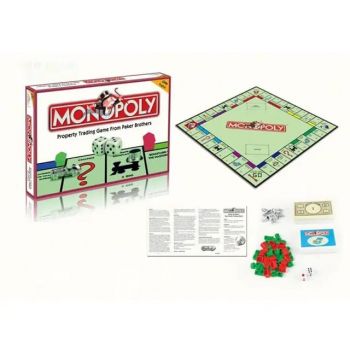
Game Overview
What makes Monopoly a lasting classic
Monopoly has been entertaining families and friends for decades because it blends simple chance with deep strategic decisions. The familiar board, colorful tokens and iconic money create an atmosphere that invites both casual players and competitive enthusiasts. Each roll of the dice can change the balance of power, making every game feel fresh while still following a well‑known set of rules.
Core rules that shape each session
The objective of Monopoly is to acquire enough property and cash to force all opponents into bankruptcy. Players move around the board by rolling two dice, buying unowned properties, paying rent when landing on owned spaces, and drawing cards that can reward or penalize them. The game ends when only one participant remains financially solvent.
Key elements that keep players engaged
- Property groups that increase rent when fully owned.
- Houses and hotels that amplify income from opponents.
- Chance and Community Chest cards that add surprise events.
- Negotiation moments that allow trades and alliances.
- Bankruptcy rules that create tension as assets dwindle.
Mastering Monopoly
Effective property acquisition tactics
Successful players focus on acquiring a complete color set early in the game. Owning all properties in a group enables the purchase of houses, which dramatically raises rent. The orange and red groups often provide the best return on investment because they are landed on frequently due to their position after the Jail space.
Cash management and rent strategies
Maintaining a cash reserve is essential to survive unexpected expenses such as taxes, fines or rent on high‑value properties. A common approach is to keep enough money to cover at least one full circuit of the board, which protects against sudden bankruptcies. When cash becomes low, consider mortgaging less valuable properties rather than selling houses.
Negotiation tips that can turn the tide
Trades should be evaluated not only for immediate gain but also for long‑term strategic advantage. Offering a property that completes an opponent’s set can be beneficial if it secures a more valuable group for you. Always calculate the potential rent increase before finalising a deal, and be prepared to walk away from offers that do not improve your position.
How to play
Setting up the board and pieces
- Unfold the board on a flat surface and place the Chance and Community Chest cards on their designated spaces.
- Each player selects a token and places it on the Go square.
- Distribute the starting cash of one thousand five hundred dollars to each participant.
- Banker manages the bank, property deeds, houses, hotels and money.
Taking a turn and moving the token
- Roll the two dice and add the numbers together.
- Advance your token clockwise the total number of spaces.
- If you pass or land on Go collect one hundred dollars.
- Follow the instruction on the space you land on, whether it is buying property, paying rent or drawing a card.
Handling property purchases and rent payments
- If the space is an unowned property you may buy it for the price shown on the board.
- If you decline to purchase, the property is auctioned to the highest bidder.
- When you land on a property owned by another player you must pay the rent indicated on the deed card.
- Rent amounts increase when the owner has a complete color set or has built houses or hotels on the property.
Frequently Asked Questions
Can I play Monopoly with fewer than four players
Yes the game can be played with two or three participants but the experience is richer with four or more because there are more opportunities for trading and competition.
What happens when a player runs out of money
The player must mortgage properties or trade with others to raise cash. If they cannot raise sufficient funds they are declared bankrupt and must leave the game, returning all assets to the bank.
Is there a digital version of Monopoly that follows the same rules
Several electronic adaptations exist and they generally replicate the board layout, property values and chance cards of the original tabletop version while adding optional features such as online multiplayer.