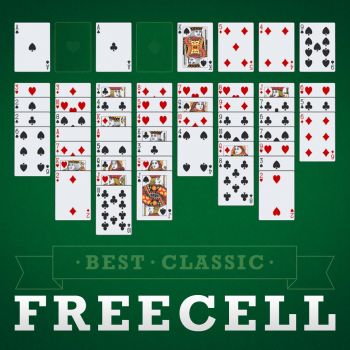
Discover the Classic Solitaire Experience of Freecell
What makes Freecell stand out among card games
Freecell offers a pure form of solitaire that relies on skill rather than luck. Every deal uses a standard deck of fifty-two cards and the entire deck is visible from the start. This transparency allows players to plan several moves ahead and to solve each puzzle through logical reasoning. The game has no hidden cards and no random reshuffling, which means that a determined mind can achieve success on any layout.
The appeal of strategic planning in a digital format
Playing Freecell on a web browser or mobile device adds the convenience of automatic scoring and instant reset. The digital interface removes the need for manual card handling while preserving the tactile feel of moving cards with a mouse or finger. Players can experiment with different strategies without the fear of damaging physical cards, making the game an ideal training ground for improving concentration and problem solving.
Deep Dive into Gameplay Mechanics and Player Controls
Understanding the layout of the tableau and foundations
The playing area consists of eight tableau columns where the cards are initially dealt. In addition there are four foundation piles that must be built from Ace to King in each suit. The objective is to transfer all cards from the tableau to the foundations following the rules of alternating colors and descending order. Empty tableau columns can be used as temporary storage for any single card, providing flexibility for rearranging sequences.
How mouse clicks and drag actions translate to moves
A single left click on a card selects it and a second click on the destination spot completes the move. Dragging a card or a stack of correctly ordered cards from one column to another is also supported. The game automatically highlights legal destinations, preventing illegal moves and helping new players learn the rules quickly. Keyboard shortcuts such as the arrow keys for navigation and the space bar for undo are often available in many implementations, offering an alternative method for precise control.
How to play
Initial setup and card distribution
- Launch the Freecell application in a web browser or on a compatible device.
- The deck is shuffled automatically and dealt evenly across eight tableau columns.
- Four empty foundation slots appear at the top of the screen, each designated for a specific suit.
Step by step actions to achieve victory
- Identify any Aces in the tableau and move them to the foundation piles.
- Look for cards that can be placed on existing foundation piles in ascending order.
- Move cards between tableau columns by placing a card of opposite color and one rank higher onto a lower card.
- When a column becomes empty, place any single card or a valid sequence into the empty space to free up other moves.
- Continue transferring cards to the foundations until all cards are stacked from Ace to King in each suit.
- If a mistake is made, use the undo function to revert the last move and try an alternative approach.
Frequently Asked Questions
Is it possible to lose a game of Freecell?
No. Because all cards are visible from the beginning, every deal has at least one solution. The challenge lies in discovering the correct sequence of moves.
Can I play Freecell without an internet connection?
Many versions of Freecell are available as offline applications for desktop and mobile platforms. Once installed, the game can be played without any network access.
How many moves does a typical game require?
The number of moves varies depending on the initial layout and the player's efficiency. Some games can be completed in fewer than one hundred moves, while others may require several hundred.
Does Freecell support multiple difficulty levels?
The standard version uses a single difficulty level because the randomness of the deal determines the challenge. Some platforms offer variations such as limited undo or time constraints to increase difficulty.
Are there any tips for improving my win rate?
Focus on freeing the Aces and low cards early, keep at least one empty tableau column for maneuvering, and avoid moving cards to the foundations prematurely if they block important sequences.